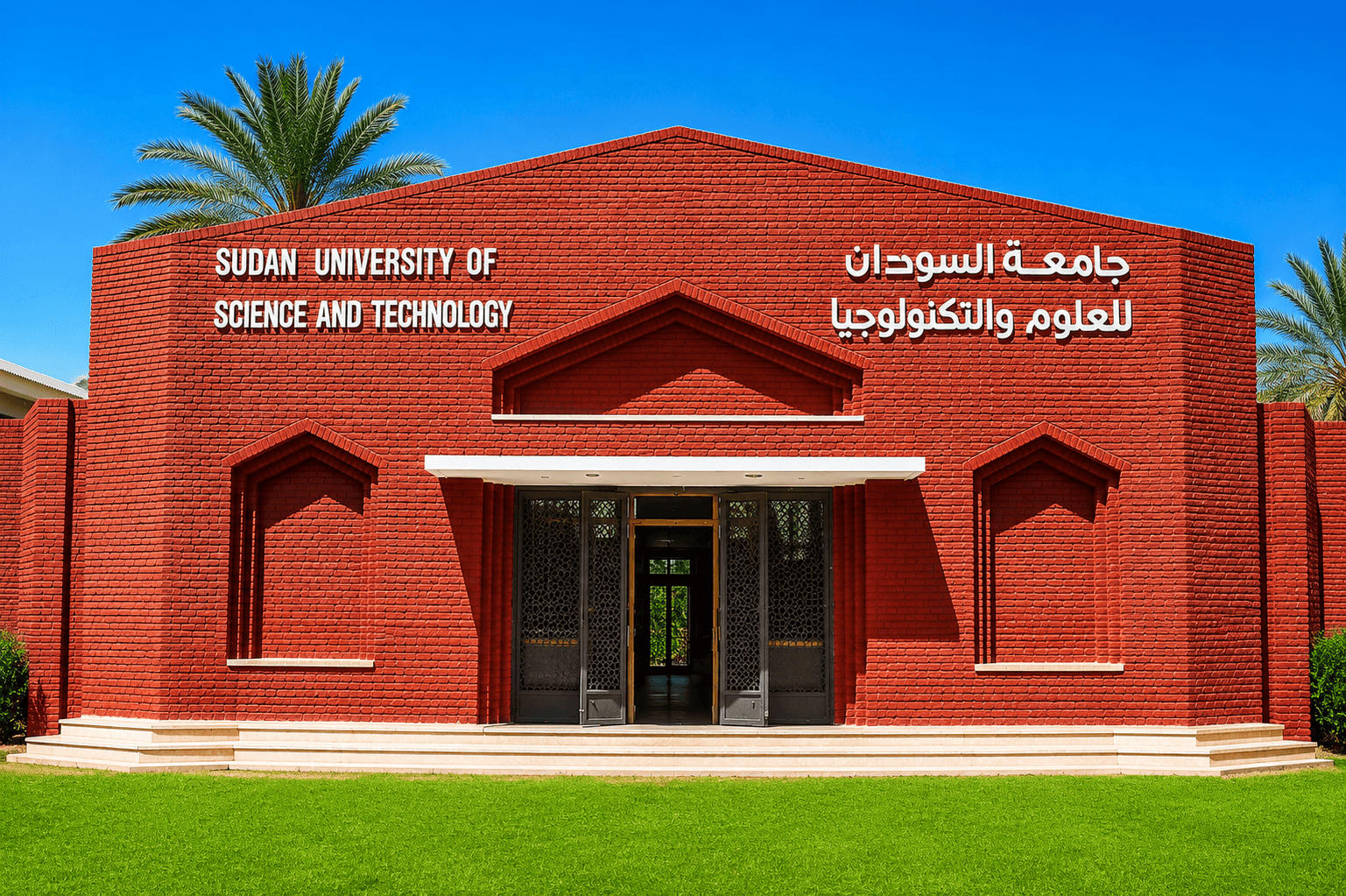
Sudan University of Science and Technology (SUST) is among the oldest and largest public institutions of higher learning in Sudan, and its history mirrors the development of technical and scientific education in the country. Its origins trace back to 1902, when the Khartoum Technical School and School of Commerce was founded during the colonial period. Over the following decades the institution grew through successive stages, becoming the Khartoum Technical Institute in 1950 and the Khartoum Polytechnic in 1975, before being elevated to full university status under its present name in 1990. This long lineage gives SUST a claim to more than a century of accumulated expertise in applied science, engineering and vocational training.
The university's main campus sits in the Al Mugran district of Khartoum, at the symbolic confluence of the Blue and White Nile, with a network of some ten campuses distributed across Khartoum State. In its most recent reported figures, SUST comprised roughly 27 colleges and schools and had grown into one of the country's largest universities, with a reported enrollment in the tens of thousands of undergraduate students together with a substantial postgraduate body and a permanent academic staff numbering in the thousands. This scale allowed it to offer an unusually broad spread of disciplines under one institution.
SUST's academic identity is anchored in science and technology. Its colleges span engineering and petroleum engineering, computer science and information technology, medicine and pharmacy, and the agricultural sciences including forestry and veterinary studies, alongside programmes in music, fine arts and physical education inherited from its earlier institutes. This breadth reflects the university's founding purpose of training the technical and professional workforce needed for national development.
The institution has also earned external recognition. It was ranked first among Sudanese universities in the Webometrics rankings in 2021 and 2022 and has appeared in the QS World University Rankings. SUST has built research and academic partnerships with international institutions including the Norwegian University of Science and Technology, the University of Oslo and Boston University, and it hosts a UNESCO Chair for Women in Science and Technology, a distinction reflecting its engagement with global scientific priorities and the inclusion of women in STEM.
For international students, particularly from across Africa and the Arab world, SUST has historically been an attractive destination: instruction in a wide range of technical fields, comparatively accessible costs, and a large, well-established academic community. Its diploma-to-doctorate ladder, spanning technical diplomas, bachelor's degrees, higher diplomas, master's and doctoral programmes, offers multiple entry points and clear pathways for advancement.
Taken together, SUST's enduring assets are considerable: an institutional heritage stretching back more than a century, a comprehensive science-and-technology portfolio, a demonstrated record in national and continental rankings, and established international academic linkages. These are the foundations on which its long-term potential rests, and they position the university as a cornerstone of Sudan's scientific and engineering capacity for the future.