

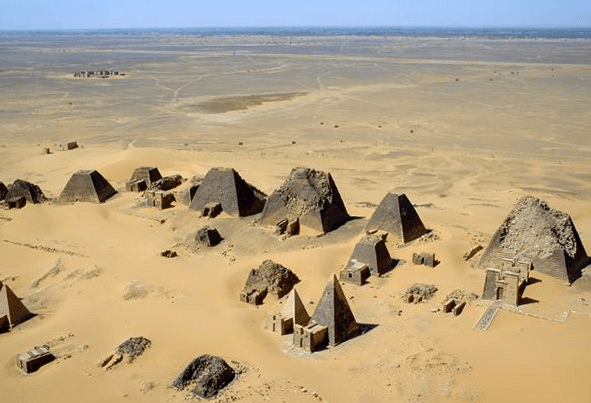
As Egypt’s New Kingdom loosened its grip on Nubia around 1070 BCE, a new Kushite kingdom took shape on the middle Nile. It would endure for well over a thousand years, from its first capital at Napata to its later seat at Meroë, and it is remembered in two great phases — the Napatan and the Meroitic.
In the eighth century BCE the kings of Kush grew strong enough to turn the tables on their northern neighbour. Under Piye and his successors they conquered Egypt and ruled the whole Nile valley as its Twenty-fifth Dynasty, from around 728 until 656 BCE — pharaohs of Nubian origin who restored Egypt’s temples and revived its ancient arts before Assyrian invasions drove them home.
At home Kush was a civilisation in its own right, not a shadow of Egypt. Its smiths worked iron on a large scale; its scribes devised the Meroitic script, the oldest known writing of an African language south of Egypt; and its people worshipped indigenous gods such as the lion-headed Apedemak alongside Amun. Its powerful queens, the Kandakes, ruled in their own name — one of them, Amanirenas, fought Rome to a standstill. Its kings were buried beneath hundreds of steep pyramids at el-Kurru, Nuri and Meroë.
Kush declined in the fourth century CE, weakened by shifting trade and the rise of Aksum, and by about 350 CE its power was spent. In its place rose the Christian Nubian kingdoms that would carry the story of the middle Nile onward.