
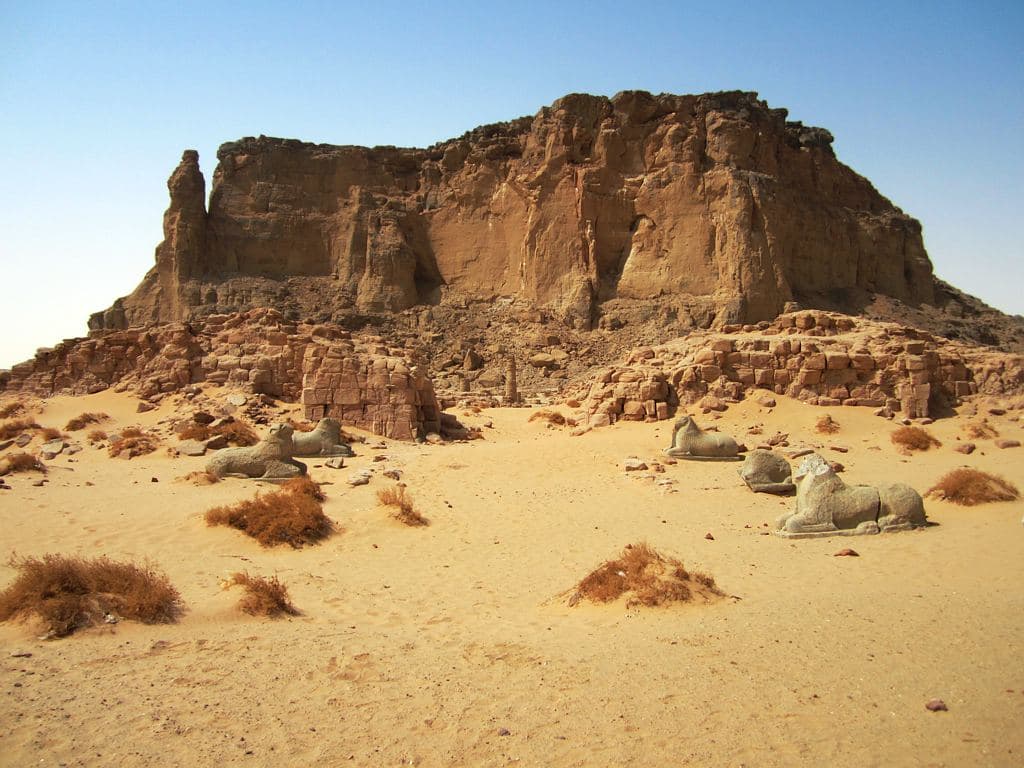
Rising abruptly from the desert plain near the town of Karima, the flat-topped mountain of Jebel Barkal has been revered as sacred ground for over three thousand years. Ancient Egyptians, upon reaching this remote southern frontier around 1450 BCE under Pharaoh Thutmose III, saw in its pinnacle the shape of a rearing cobra — the symbol of kingship — and declared it the southern home of the god Amun, king of the gods.
Centuries later, as the Kingdom of Kush rose to power, Jebel Barkal became the spiritual and political heart of the Napatan dynasty, whose kings would go on to rule Egypt itself as the 25th Dynasty. At the mountain's base stand the ruins of the Temple of Amun, once approached along a processional avenue lined with stone rams, alongside the smaller Temple of Mut and a cluster of Napatan-era pyramids — steeper and more modest than those at Meroë, but built with the same reverence for the afterlife.
Jebel Barkal and the surrounding archaeological sites of the Napatan region were inscribed on the UNESCO World Heritage List in 2003, in recognition of a religious and cultural legacy that shaped both Nubian and Egyptian civilization for over two thousand years.