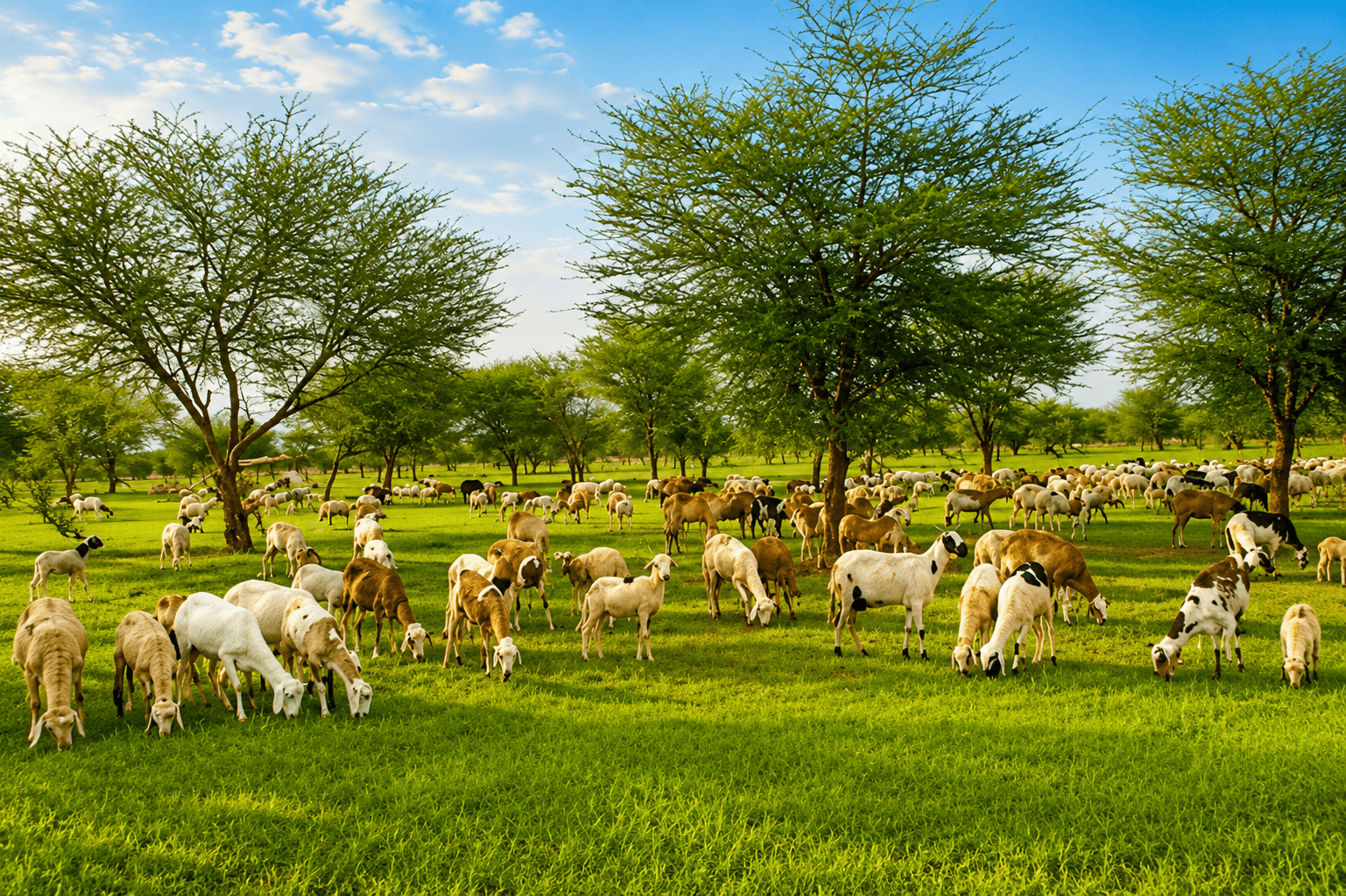
Livestock is one of Sudan's defining economic and cultural assets. The country supports one of the largest animal populations in Africa: recent estimates place the national herd at well over 100 million head, with figures for 2023 around 111.8 million — roughly 41 million sheep, 33 million goats, 33 million cattle, and 5 million camels. That scale places Sudan consistently among the top two or three African countries for cattle, sheep, goats, and camels, and gives it one of the deepest reservoirs of animal protein and breeding stock on the continent.
The sector's economic weight matches its size. Livestock has historically provided on the order of 40 percent of agricultural employment and around a third of agricultural GDP, and it is a cornerstone of non-oil exports. Animal-sector exports have typically represented just under half of all agricultural exports and close to 30 percent of non-oil export earnings, making livestock — after gold — one of Sudan's most valuable export categories. In a representative recent year, live-animal exports were led by sheep (around 226 million US dollars) and camels (around 173 million), followed by cattle and goats, with chilled and frozen meat adding roughly 100 million and hides a further contribution.
Sudan's export orientation is anchored in geography and long relationships with Gulf and MENA buyers. Live sheep flow principally to Saudi Arabia — where demand peaks around the Hajj and Eid seasons — while camels are exported largely to Egypt, and chilled and frozen meat serves Saudi Arabia, other Gulf states, and Egypt. These corridors are well established: even under the strains of recent years, recorded shipments have continued, with tens of thousands of sheep documented as exported to Saudi Arabia in early 2026. Proximity to Red Sea shipping routes and to high-value Gulf protein markets is a durable structural advantage.
Production rests on an extensive pastoralist and agro-pastoralist system spread across vast natural rangelands, with the Darfur and Kordofan regions together accounting for well over half of the national herd. This traditional, low-input model has proven resilient and carbon-efficient, but it also leaves substantial room for productivity gains through improved animal health, nutrition, water points, and market organisation.
The investment opportunity is correspondingly broad and largely downstream. Sudan exports predominantly live animals and raw or lightly processed products, meaning much of the potential margin in meat, leather, and dairy is realised elsewhere. Priority areas include modern feedlots and fattening operations to raise carcass weights and consistency; export-standard abattoirs and cold-chain logistics to shift the mix from live animals toward higher-value chilled and processed meat; veterinary services, disease surveillance, quarantine, and internationally recognised certification to unlock and stabilise premium markets (including Gulf, and potentially European and East Asian, buyers); tanning and leather processing to capture value from hides currently exported raw; and dairy processing to serve a large domestic and regional market. Complementary investment in animal feed, fodder cultivation on irrigated land, and traceability systems would reinforce the whole chain. Taken together, Sudan's herd size, established buyer relationships, and clear value-addition gap make livestock one of the country's most compelling long-term investment stories.