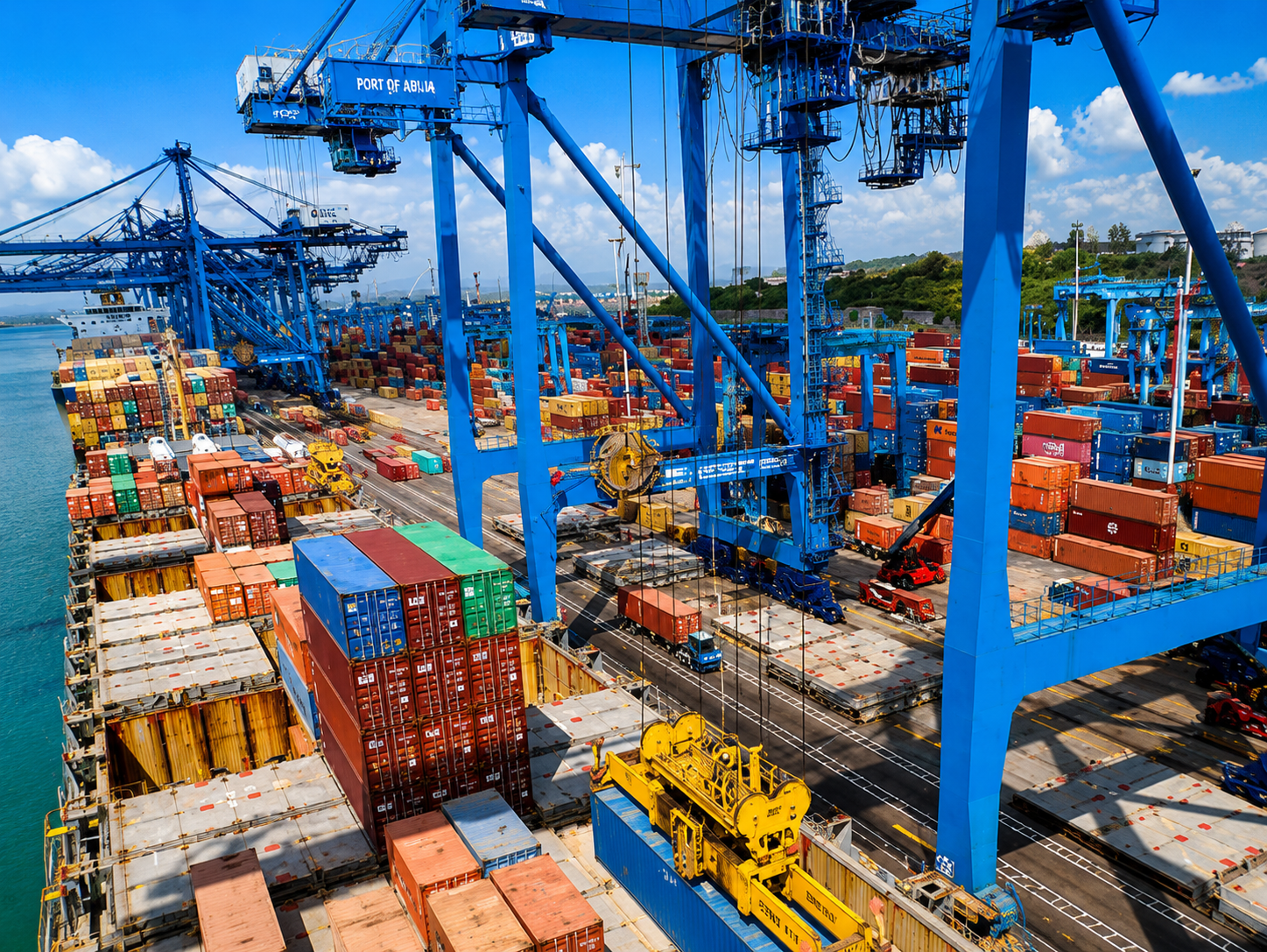
Sudan's geography gives it a structural advantage that no amount of turbulence erases: it is the natural bridge between the Red Sea and the vast, landlocked interior of north-central Africa. The centrepiece is Port Sudan, the country's principal deep-water gateway and one of the busiest ports on the African side of that waterway. In a normal year it handles the great majority of Sudan's maritime trade, on the order of four billion US dollars in exports and 7.5 billion in imports, through facilities that include a container terminal rated at around 800,000 TEU per year and multiple bulk and container berths. Sitting on one of the world's most important shipping lanes, between the Suez Canal and the Bab-el-Mandeb, it is well placed to serve as a regional trans-shipment and logistics hub. The recognized upgrade path, deepening berths toward 18 metres, modernizing cargo-handling equipment, and adding warehousing and logistics zones through partnerships with international operators, defines a concrete pipeline of investable projects.
Inland, Sudan possesses one of Africa's most extensive railway systems, with roughly 4,500 to 4,700 kilometres of track historically linking Wadi Halfa on the Egyptian border, Khartoum, Port Sudan, and the agricultural west via Sennar, Kosti, and El-Obeid. The Khartoum to Port Sudan main line alone carries more than two-thirds of national rail freight. The network has aged and much of it needs rehabilitation, but the alignment is strategic and the rehabilitation opportunity is large. Ambition is returning at a continental scale: the proposed Dakar to Port Sudan railway would create a trans-African artery of some 10,000 kilometres linking the Atlantic to the Red Sea, and agreements have been floated to extend rail from Port Sudan toward Adre in eastern Chad, with onward connections envisaged to the Central African Republic, South Sudan, and Ethiopia.
That corridor logic is the heart of the infrastructure rationale. Chad, the Central African Republic, South Sudan, and to a degree Ethiopia are landlocked or under-served by ports, and for much of the Sahel the shortest reliable route to blue water runs through Sudan. Every kilometre of upgraded road, rail, and port capacity therefore serves not one national market but a regional catchment of several countries. The River Nile adds a further axis, a source of water, irrigation, and, on navigable reaches, transport, around which population and economic activity have clustered for millennia.
For investors and development partners, the enduring asset is location: a coastline on a strategic sea, a capital astride the confluence of the Blue and White Niles, and rail and road corridors that reach deep into the continent. The potential lies in modernization delivered through public-private partnerships, concessions, and regional financing, spanning port terminals, dry ports and logistics parks, rail rehabilitation and new links, and the road corridors that knit the Sahel to the sea. It is a legacy of connectivity waiting to be brought up to modern standard.