
More than a thousand years after the fall of Meroë — and after the long age of the Christian Nubian kingdoms that followed it — the middle Nile was united once more. In 1504 Amara Dunqas founded the Funj Sultanate, with its capital at Sennar on the Blue Nile, as the last Christian kingdom of Alodia gave way. Remembered as the “Blue Sultanate”, it would endure for more than three centuries.
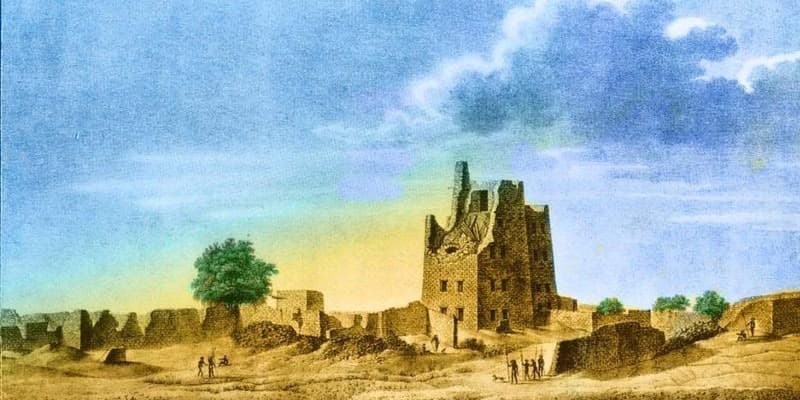
At its height the sultanate reached from the Third Cataract to the edge of the rainforest, uniting the Gezira plain between the two Niles under a single throne. Under Funj rule Islam and the Arabic language spread widely across the region, carried by Sufi teachers, and Sennar grew into one of the great cities of its day — a celebrated centre of trade and Islamic learning whose mud-brick great mosque still stands in ruin.
The Funj turned back an Ottoman advance up the Nile at the Battle of Hannik in 1585, fixing the northern frontier for generations. In its final century real power passed to the Hamaj regents while the sultans reigned in name, and in 1821 the weakened state fell to the invading army of Muhammad Ali of Egypt — opening a new chapter in Sudan’s history.