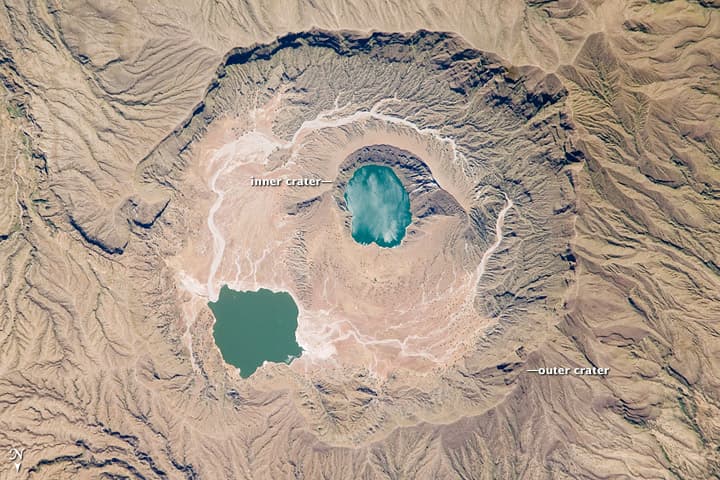
At the summit of Jebel Marra, Sudan's highest point since South Sudan's independence in 2011, lies a landscape so striking it is visible even from orbit. The Deriba Caldera — a five-kilometre-wide volcanic crater formed by an explosive eruption roughly 3,500 years ago — cradles two lakes within its walls: a deep freshwater lake in the throat of the most recently active vent, and a shallower, saline lake nearby. Hot springs and fumarole vents still stir nearby, evidence that the volcano, though dormant, is not extinct.
Fed by the surrounding highland's relatively high rainfall, the caldera and its slopes support a lush microclimate utterly unlike the semi-arid plains that stretch away in every direction below — forested ravines, cascading waterfalls, and permanent streams almost entirely cut off from the rest of the continent's water systems, forming a unique high-altitude ecosystem found nowhere else in Sudan.
The Fur and Zaghawa communities who farm Jebel Marra's fertile volcanic slopes have long known the mountain's beauty; from above, the twin lakes of Deriba reveal that beauty on an entirely different scale.